
5 ideas that took over Money20/20 USA 2026
The 5 ideas that took over Money20/20 USA 2026
The experiments are over. At Money20/20 USA 2026, over 300 sessions in Las Vegas (October 19 to 21) moved the conversation from what AI, stablecoins and instant payments might do to who runs them, who pays when they fail, and who gets left out.
Five ideas took over 300 sessions across Money20/20 USA: agents that spend, stablecoins as infrastructure, trust as a product, rails that scale out from Latin America, and data that opens up credit.
1. Agents Stop Advising and Start Spending
By the numbers: Agent or agentic talk in over 180 sessions. Speakers described agents already working for analysts, traders and contact center teams, then asked what it takes to scale them.
Multiple sessions explored:
- Agents with a wallet: Agents connect discovery, comparison and checkout, and Mastercard expects 1 in 10 transactions to be agent-led by 2030, or sooner
- Banks at scale: BNY put agents in front of every employee and measured only adoption through 2024 and 2025
- Support turns profit center: Customer service shifts from a cost center to a revenue line
- Legacy rewritten for banks: AI maintains or rebuilds old bank systems, a point raised in 28 sessions
That raised harder questions about:
- Pilot to production (66 sessions): Smaller teams and faster builds don't guarantee better margins once compute and operating costs are counted
- Data first: Agents need consistent, authoritative data to make sound decisions
- Permission (58 sessions): Spending limits, merchant restrictions and human approvals have to be built into the payment architecture
- Proof of trust: Identity, customer intent and authorization must travel with the transaction, and "Know Your Agent" came up in 13 sessions
- Liability (52 sessions): Someone must own disputes, compromised agents and unauthorized purchases
- Guardrails (45 sessions): Human-in-the-loop controls
Permission was the most contested question. One panel cited research in which 3 in 4 US AI users wanted an agent to act, not just advise. Speakers argued that consent frameworks built for people need policy, budget and timing limits for agents, and that many so-called agentic payments are really a chat triggering an old workflow. Jefferies still doesn't let colleagues share agents, because access control isn't solved.
The broader implication: the model is no longer the bottleneck. Data, access control, cost and accountability are.
In the headlines

OnePay introduced Agentic Banking, which gives an agent its own funded sub-account, single-use card credentials, spending caps and an off switch, so it never touches the customer's full balance.
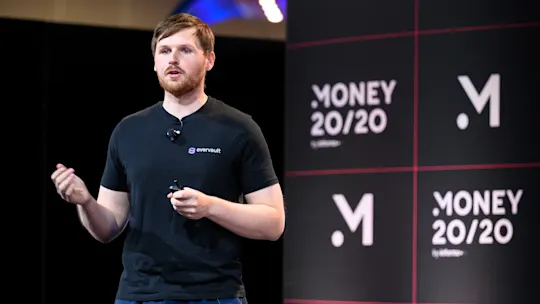
Evervault launched Browser Tokens, which let an agent check out on existing sites without ever seeing a card number or password.
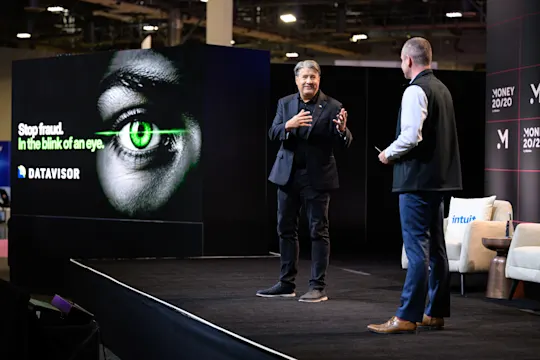
DataVisor unveiled Vera Code, an AI agent that builds and tests fraud and AML programs while people approve every change.
2. Stablecoins and Tokenization Become Core Financial Infrastructure
By the numbers: stablecoins mentioned in 121 sessions and tokenization in 64. The framing was settlement and infrastructure, not speculation.
Multiple sessions explored:
- Real volume: Fireblocks says stablecoins are now about 78% of the roughly $7 trillion moving through its wallets, up from under half two and a half years ago
- Tokenized cash first: Digital cash supports settlement while tokenized investment products expand its use. BCG sizes stablecoins at about $300 billion and tokenized real-world assets at about $30 billion today, heading past $20 trillion by 2030
- Always on: Settlement for equities, gold, funds and credit runs through weekends and holidays, easing liquidity management
- Banks at a fork: Stablecoins or tokenized deposits (18 sessions)
The discussion then turned to:
- The GENIUS Act (11 sessions): The enabler, with a January deadline for banking regulators to implement it
- The CLARITY Act (5 sessions): Passed the House, stalled in the Senate. Policy20 examined jurisdiction, intermediary obligations, developer protections and bank participation in digital assets
- The policy gap: Stablecoin rules don't settle every question about digital asset market structure or institutional participation
- Charters (14 sessions): Charters, deposit-insurance approval and third-party standards are different routes to scale, from Stripe's Bridge national trust bank to Fiserv's limited-purpose bank
- Integration: Customers want familiar workflows with secure custody and reliable reconciliation, with stablecoins, tokenized deposits and traditional rails working together
- Irreversibility: KYC, sanctions screening and wallet checks still apply when transactions can't be reversed
One cross-border player has moved almost $10 billion for 6 million users across 11 Latin American markets on stablecoin rails. Panelists called regulation what made that possible, not an obstacle. Policy20 gave policymakers and the industry a room to talk digital assets, AI regulation and interoperability, and what it takes for change to happen.
In the headlines

Mastercard launched Stablecoin Security, which screens stablecoin payments for fraud and sanctions risk, with Borderless.xyz and Keyrails as launch partners.

Visa and Mesh partnered so consumers can spend crypto and stablecoin balances at Visa merchants without a separate card.

The World Gold Council and BCG sized the digital gold market at $45 to $55 billion, with up to $700 billion of latent demand.
The broader implication: the question is no longer whether banks will touch stablecoins, but whether they get them to clients before fintechs with their own charters do. One infrastructure provider warned that banks that hold back risk being marginalized.
3. Trust Becomes the Product
By the numbers: trust in 152 sessions, fraud in 121, identity or KYC in 99. Almost every conversation about agents, stablecoins or instant payments circled back to them.
Multiple sessions explored:
- An army, not a gang: AI cuts the cost of attacking, so defenders now face an army instead of a few groups
- First-party fraud: Customers using an LLM to coach themselves through chargebacks
- Crypto's lessons: What crypto already learned about fraud is heading for banks
- Shared intelligence: Fraud moves across networks, so intelligence should too
- Breaches: Response and crisis communications (24 sessions touched cyber or breaches)
Panels kept returning to:
- Identity and KYC (99 sessions): The foundation for everything else
- Safeguards for faster money: Identity verification, information sharing, fraud prevention and clear responsibility must keep pace with payment speed, a Policy20 point
- Accountability (52 sessions): Who owns the loss when something goes wrong
- Explainable AI (32 sessions): Including a session on AI that can pass an audit
- Consumer skepticism: 2/3 of consumers distrust AI, according to one CMO panel, so relationships stay a competitive asset as service, products and human judgment matter more in automated journeys
The scale: $21 billion in reported US internet crime losses last year, and 22,000 AI-related complaints. In a closing Exchange stage session on day two, a security founder described an AI-cloned voice used to stage a fake kidnapping call to his mother, and argued the industry has to protect consumers at the end of the attack chain.
Banks and card networks treated trust as a commercial advantage, not a compliance cost. PNC called its brand "brilliantly boring."
In the headlines

World launched World ID for Banking and Finance, with proof-of-human checks, a Zoom deepfake check and agent authentication for banks.

LexisNexis Risk Solutions put a number on the problem: US financial firms lose $5.47 for every $1 of fraud, up from $4.00 in 2021, and about a fifth of losses trace to AI-generated techniques.
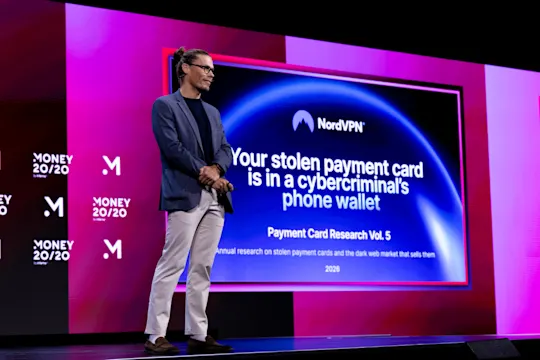
NordPass added tools that mask personal details on sign-up forms and monitor national ID numbers for breaches.
The broader implication: trust has to be provable across people, agents and models, and the institutions that prove it keep the customer.
4. Real-Time Rails Go Global, and Latin America Leads
By the numbers: real-time or instant payments in 94 sessions, cross-border in 69, and Latin America in 55. Speakers treated the region as the place where instant payments already work at scale.
Multiple sessions explored:
- Pix and Breve: Default rails in Brazil and Colombia, with Google Pay designing products around them (Pix came up in 11 sessions)
- Brazil's open finance ecosystem: Scaled to tens of billions of API calls per month (with records hitting 30 billion to over 45 billion monthly)
- Stablecoin payouts: Remittances and payouts into Latin America, including a product built inside WhatsApp (18 and 19 sessions)
- US catch-up: FedNow and RTP (16 sessions)
Conversations about those rails centered on:
- Building on top: Subscriptions, checkout and new financial services on instant rails
- Interoperability (35 sessions): Shared standards and interoperable data and payment infrastructure expand competition, improve access and support new services
- Local versus global: Local infrastructure against one global network for cross-border
- Open finance (15 sessions): The next layer
- Partnering well: Banks keep control of their architecture while working with specialists, and partnerships work when they solve a shared problem and bring market access, credibility and balance-sheet support
Fast isn't enough. Intuit argued that real-time payments only help small businesses if they sit inside the workflow, since the real issue is liquidity and cash flow. Paper checks persist because manual processes do.
In the headlines

Thunes and Coinbase paired Thunes' fiat payout network with Coinbase's stablecoin rails.
Newline by Fifth Third and Visa extended Visa's Multinational Program so eligible fintechs can issue corporate cards in more than 40 countries.

FXC Intelligence and Money20/20's cross-border white paper drew on 650 articles and found interoperability the leading theme, with stablecoins the US focus.
The broader implication: instant is the baseline. The competition is moving to the context, workflow, and data around the payment.
5. Better Data Opens Up Credit
By the numbers: lending in 68 sessions, liquidity or working capital in 63, small business in 50, embedded finance in 44, inclusion in 35, and alternative data or cash-flow underwriting in 34. Several sessions were built entirely around who gets served.
Multiple sessions explored:
- Cash flow beside the score: Cash-flow data as a complement to the credit score, including a session on a cash-flow data bureau
- The invisible prime: Creditworthy people with no score or a thin file. The CFPB counts about 45 million credit-invisible US adults, and one analyst says 1 in 3 adults are misclassified
- "Bizoomers": Gig workers, freelancers and 1099 earners who are half consumer, half small business (18 sessions)
- One toolkit: Small businesses want connected tools in place of separate payment, payroll and invoicing apps
Sessions dug into:
- Underwriting beyond the W-2 (26 sessions): Models that look past a single income source
- Is inclusion dead? One session asked outright
- AI visibility: AI helping smaller fintechs compete for attention and customers
- Liquidity first: Working capital is the real constraint for small businesses, ahead of payment speed
Inclusion got pitched as a business opportunity. The credit-invisibles workshop opened by telling the room this was about more loans and more revenue.
Credit unions pushed the same goal from the member side. They came up in 28 sessions (14 of them three times or more), including PenFed on members wanting AI, AI-driven personalization, cooperation as a route to democratizing finance, and the credit union versus bank versus fintech debate. The US Content Team's notes boiled it down to four points: personalization should lead to useful action, not more messages; AI should equip employees as well as members; unified data and governed platforms move institutions from experiments to capabilities used across the organization; and cooperation multiplies capability.
In the headlines

Omnisient won the Banking Grand Prix at the Money20/20 Money Awards in October 2026 for its financial inclusion initiative using grocery shopping data (Basket Signals) to help banks assess credit-invisible consumers.
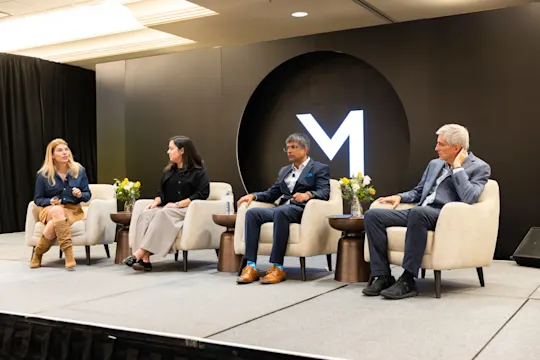
Filene publishes wrap up on credit union leaders' takeaways around AI, member engagement, and collaborative technology strategies.
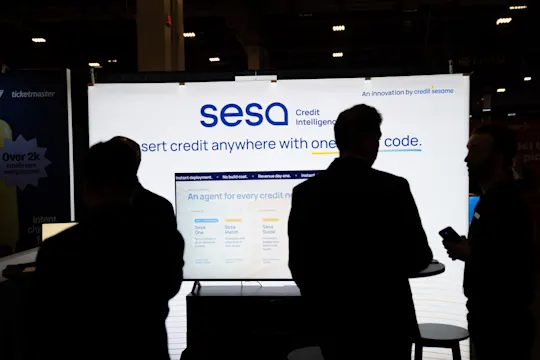
Credit Sesame introduces Sesa: A one line of code that delivers an entire credit ecosystem - an AI agent that meets consumers at the point of credit intent.
The broader implication: the next lending growth sits with customers institutions already have but can't see. The winners will read the data behind the score.
